CCC TURMOIL: A FRAGMENTED OPPOSITION AND THE HAND OF STATE INTERFERENCE
In the tumultuous arena of Zimbabwean politics, the Citizens Coalition for Change (CCC), once seen as the country’s brightest hope for democratic renewal, has become a fractured symbol of internal betrayal and external manipulation. While the media has recently painted the formation of an “interim steering committee” within the CCC as a fresh twist, this narrative fails to grasp the deeper, long-running dysfunction that has plagued the opposition party. This committee is no recent innovation—it has been central to the party’s unraveling, particularly through the controversial recall of elected officials that shook the very foundation of the movement.
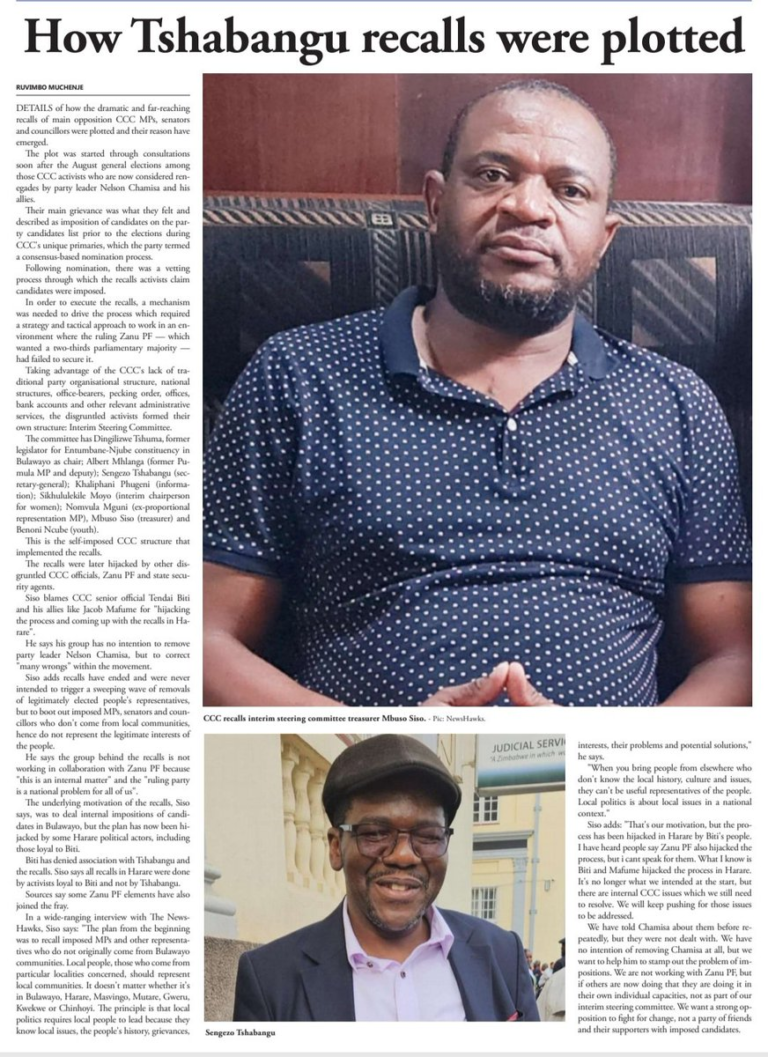
At the heart of this internal chaos is Dingilizwe Tshuma, a former MP for Entumbane-Njube in Bulawayo, who leads the committee. Under his leadership, what was once billed as an internal mechanism for order has become the engine of recalls, sowing discord and effectively tearing the CCC apart. Far from a mere administrative body, the committee has played a deliberate and strategic role in weakening the party, dismantling structures of accountability, and sidelining key players.
Its members are no political novices. Figures like Albert Mhlanga, the former Pumula MP and his deputy; Sengezo Tshabangu, now serving as secretary-general; Khaliphani Phugeni in charge of information; Sikhululekile Moyo, the women’s chairperson; Nomvula Mguni, a former proportional representation MP; Mbuso Siso, the treasurer; and Benoni Ncube, head of the youth wing—all bring deep-rooted knowledge of the party’s systems. But instead of using their positions to build, they have collectively contributed to the party’s internal collapse.
The recalls began in Bulawayo but quickly metastasized. CCC officials, aided by ruling party operatives from Zanu PF and partisan elements within state security, seized on the chaos to expand the disruption. What started as an internal disciplinary process was hijacked, becoming a political weapon aimed at neutralizing the opposition from within. The goal was never just internal discipline—it was destabilization.
The effects have been devastating. The CCC has gone from being a beacon of hope to a cautionary tale of infiltration, mistrust, and lost momentum. Once viewed as a genuine alternative to the Zanu PF regime, the party is now engulfed in a legitimacy crisis. Ordinary citizens, activists, and potential voters are left bewildered. How can a party so divided promise unity for a nation? How can a leadership so entangled in infighting and manipulation claim the moral authority to govern?
But this is not merely a story about poor leadership or factionalism. It is a tale of calculated sabotage. The involvement of Zanu PF elements and state security agents reveals a far more sinister dimension—a coordinated attempt to exploit CCC’s weaknesses, divide its ranks, and ensure the ruling party remains unchallenged. The so-called steering committee was never neutral. It has operated as a trojan horse, opening the gates for regime interests to dominate the opposition narrative.
This is why reducing the CCC’s crisis to internal party politics misses the point entirely. Zimbabwe’s democracy is under siege—not just through ballot manipulation or violent crackdowns, but through sophisticated internal destabilization of the opposition. The CCC’s story is a warning: no political movement can survive without strong internal safeguards, unity of purpose, and resistance to external manipulation.
As Zimbabwe marches toward the future, the need for a resilient, transparent, and principled opposition is more urgent than ever. The CCC must either find a way to heal and reclaim its mission—or risk becoming another cautionary footnote in Zimbabwe’s long struggle for change.


